Proof before autonomy
Inspect a capacity decision.
Explore a synthetic capacity request, compare it with the modeled result, and see the question the decision owner still needs to resolve.
Sample capacity decision brief
Synthetic · Fixture B
Model screen: REPAIR
A smaller commitment needs review
- Requested increment
- 7.0 MW
- Modeled eligible increment
- 5.8 MW
Additional to the 20.0 MW reference. 2026-09-22 · 00:00–01:00 UTC.
Decision still to make
Would the reduced 5.8 MW profile still meet the service and commercial requirement?
Synthetic · Economics unestimated. No operational authority.
Result and assessment limits
The proposed 7.0 MW increment exceeds the fixture’s modeled 5.8 MW increment. A reduced workload profile requires review.
Proposed revised increment: 5.8 MW
Economics unestimated. Operator acceptance and delivered capacity: not applicable. This synthetic model screen provides no operational authority.
Change scenario or perspective
Explore a hypothetical minimum
Fixture B records no minimum. These assumptions do not change the assessment.
| Assumed minimum | Revision minus minimum |
|---|---|
| 5.0 MW | +0.8 MW |
| 5.8 MW | 0.0 MW |
| 6.0 MW | −0.2 MW |
| 6.5 MW | −0.7 MW |
| 7.0 MW | −1.2 MW |
This arithmetic comparison does not change fixture B, establish feasibility, or assign a workload to equipment. All recorded conditions and operational and commercial reviews still apply. Economics remain unestimated.
Use an interactive minimum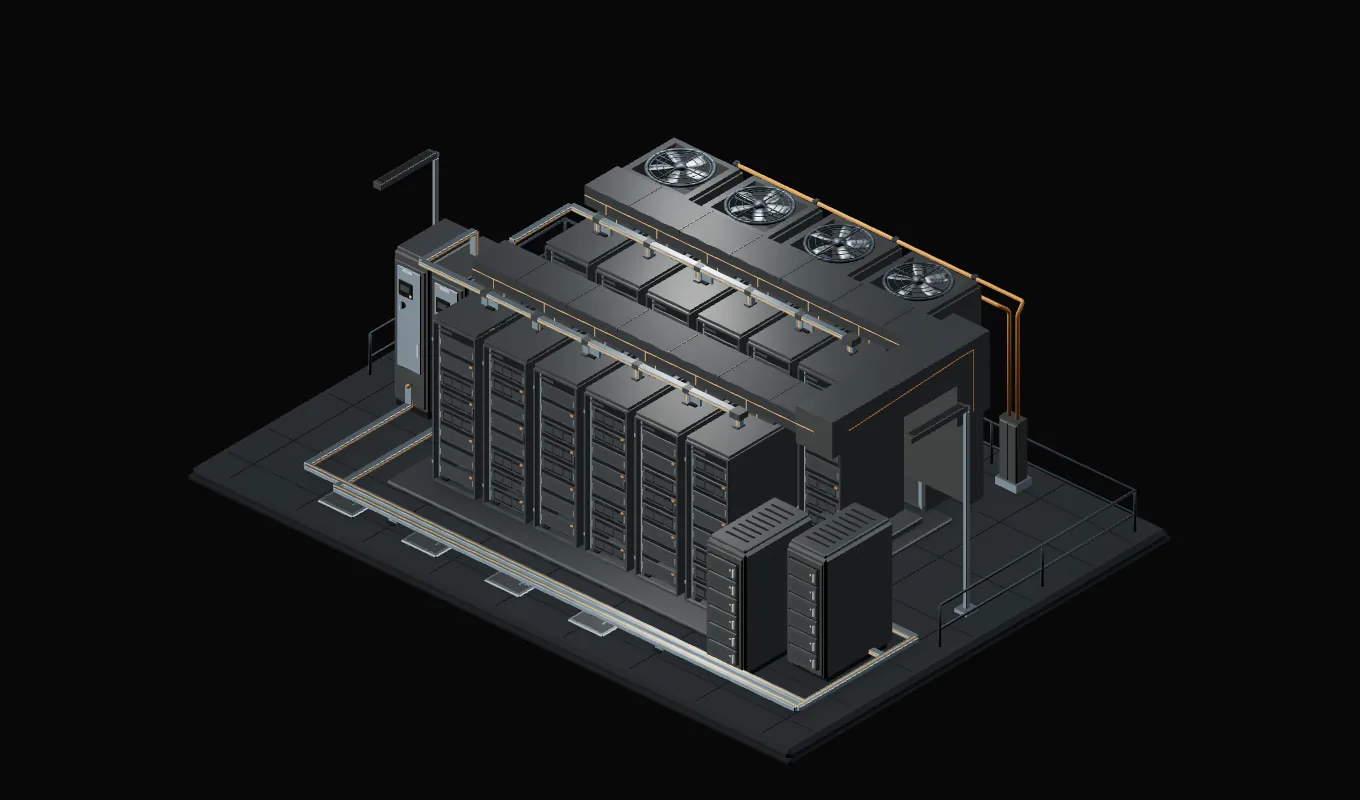

Explore the illustrative power and cooling paths. Read the versioned assessment for the result and its limits.
Explore the facility in 3DView still illustrationConditions and assessment evidence
Governing conditions
- Request exceeds the modeled increment. The proposed revision is 1.2 MW below the request. No minimum commercially viable workload is specified for this fixture.
Commercial and operational status
Economics unestimated. No price, utilization, investment cost, or commercial service requirement has been assessed.
Report acceptance: not applicable. This is an authored example, not an accepted customer report.
No operational authority. Model screening is separate from permission to operate, operator acceptance, and delivered capacity.
What this example assumes
- Every MW quantity is additional load above a steady 20.0 MW reference at the same fictional facility meter.
- The authored assessment window is one hour; the example does not model ramp, rebound, or workload transitions.
- For A–C, the example assumes the listed evidence is sufficient for the stated modeled screen.
Options to investigate · all unassessed
These are questions for a scoped assessment. No ranking, feasibility, cost, benefit, or recommendation has been established.
- Phase the workload — unassessed
- Assess another time window — unassessed
- Investigate cooling investment — unassessed
- Investigate bridge power — unassessed
Limits of this evidence
- All inputs and results are synthetic. They are not measured customer results or a guarantee of recoverable capacity.
- The model screen provides no permission to operate equipment or commit capacity.
- Site validation, authorized data, operational review, and commercial review would be required for a real decision.
Read “Follow one workload”
Illustrative sequence · 24 seconds of presentation, not simulated facility time. Motion does not calculate capacity, temperature or flow.
Request
7.0 MW requested for the whole facility, additional to the 20.0 MW reference. 2026-09-22 · 00:00–01:00 UTC. The highlighted rack represents where a workload depends on equipment; no share of this increment is assigned to that rack.
Workload placement, ramp and transitions are not modeled in this assessment.
Electrical path
Follow the representative rack’s authored feed to its row busway and electrical source. Neighboring rack feeds remain separate. These connections describe construction, not equipment ratings or available capacity.
Authored nominal headroom and reference load; no connection to a live facility.
Air and cooling
The illustrative air path passes through the rack, rear exhaust chimney and warm return plenum to the cooling assembly. Heat transfers across the coil to a separate water circuit; cooled air returns through the room. Presentation timing does not represent a cooling response delay.
Authored cooling margin for the fixed window; no physical feasibility validation.
Governing conditions
The sequential attribution accounts for authored electrical reserve, cooling margin, service reserve and evidence margin. These ordered reductions are not independent equipment bounds, and they do not identify a single limiting asset.
Independent storage capacity, contribution and dispatchability are unassessed. No reserve duration or discharge is modeled.
Screening result
Model screen: REPAIR. 5.8 MW modeled eligible increment. The proposed 7.0 MW increment exceeds the fixture’s modeled 5.8 MW increment. A reduced workload profile requires review.
Would the reduced 5.8 MW profile still meet the service and commercial requirement?
Evidence
Read fixture B, publication v1.0.0, for this exact result and its assumptions. All inputs are synthetic; economics are unestimated. No site action is authorized.
Accepted and delivered capacity are not applicable. The visual adds no operating authority.
Requested: 7.0 MW. Proposed revision: 5.8 MW. Would the reduced 5.8 MW profile still meet the service and commercial requirement?
Read the versioned brief · Download this PDF · Download this technical record
Your capacity decision
What decision is your team facing?
Tell us about the capacity commitment your team is considering and the historical inputs available. We will review fit and readiness before agreeing a paid scope, price and schedule.
Related operator resources
Continue the proof path
- Evidence informs a decision. Authority stays explicit.Understand the evidence and permissions needed before Shadow Mode, advisory review or bounded autonomy, and the limits of the public synthetic sample.
- How much virtual capacity is safe, for how long, and under which evidence?Learn how a dispatch envelope constrains data center actions by electrical, thermal, reserve, workload, water, and SLA limits before execution.
- Tell us where capacity is constrained.Start a scoping conversation about a bounded capacity assessment, input readiness, deliverables, decision responsibilities, or a partner investigation.